
The Tatami Galaxy and Animation at Large
like Nemo??


Firstly, an apology to you. I signed a lease (awesome), started a business plan (gave up on it), and thunk no thoughts for a couple of weeks (months). As the SAG-AFTRA strike marches doggedly onwards, I have been thinking deeply about cinema, television, and all that I consume. Recently, I read that the East Coast WGA has pledged to include animation writers within their ranks, and animation studios at Warner Bros. and Cartoon Network have also begun unionization efforts. Animation writers, artists, and technicians belong to TAG (the animation guild) and have historically earned less than their counterparts in the WGA. For some months the production schedules of animation have been unaffected. As the strike continued, the bubble protecting animation from current uncertainty in entertainment burst. Unfair wages, the need for striking voice actors, and the continued underappreciation of animators have led to want for change.
Animators are continually overworked and underpaid to a ludicrous degree everywhere from Hollywood to Tokyo. Today’s read is about animation’s impact on me, on our generation, and one of my favorite projects of all time.
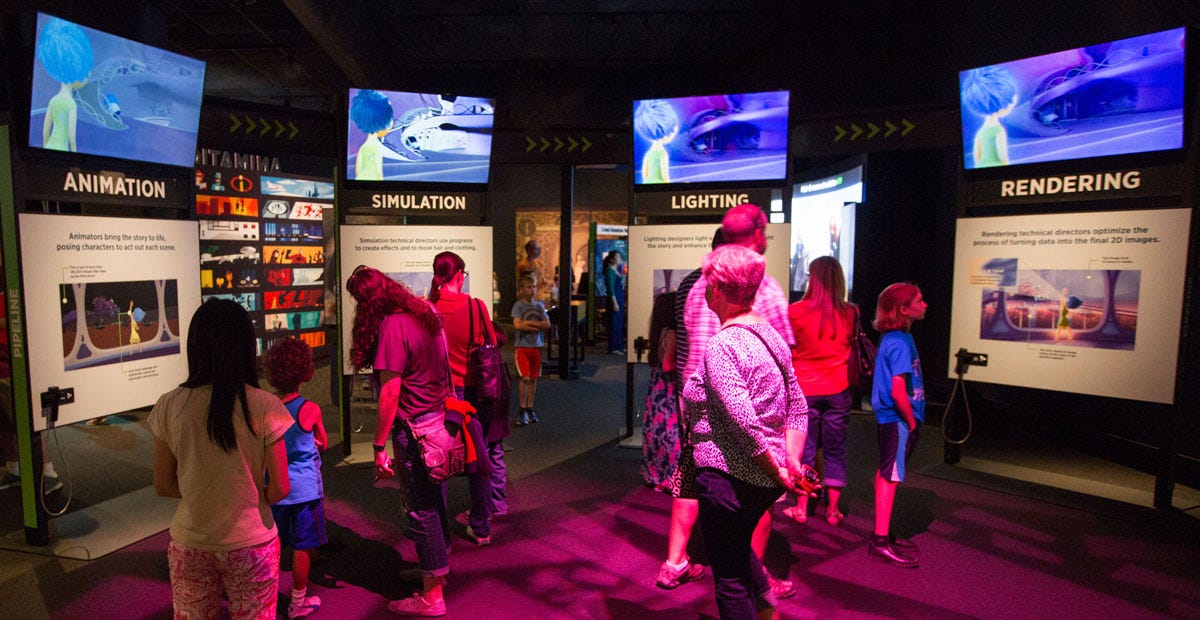
In June, Matthew and I went to the Pixar animation exhibit at the Perot Museum of Science. There, visitors could build their own characters, rig them with flexion points, color them, texturize them, and learn that rendering the characters into their final form would take several hours or even weeks. I felt wracked with guilt even as I was mucking around the exhibit. I, of course, knew that animation was hard, thankless work— but when I learned more about the intricacies of the process, I was shamed by my casual enjoyment and, at times, dismissal of such a labor-intensive medium.
Our generation was raised by computerized animation. Before there were iPad kids, there was putting your children in front of the T.V. to happily watch Finding Nemo for the 77th time (someone put this movie on to distract me the day my mom gave birth to my brother). During our childhoods, Disney and Pixar merged in 2006 and went on to produce some of the most iconic animated features (Cars, Ratatouille, Wall-E, Up, Tangled). And even before, the 90s was a hotbed of animated activity in the Disney wheelhouse (The Lion King, Mulan, Toy Story, etc.). My sister was born in 1994, the same year The Lion King premiered. Ever since she saw it, 6 years before I was born, it became a part of her. The family dog is named Simba. I’ve met many family dogs named Simba.
From full-length features like Satoshi Kon’s Perfect Blue (1997) to American cartoons like Avatar the Last Airbender (2005), I’ve grown up alongside the medium. I started with the Disney-Pixar and Studio Ghibli films, then the Cartoon Network and Nickelodeon shows (Adventure Time and Invader Zim). I went on to watch anime (like Death Note) and so-called “Adult Animation'' like The Boondocks (2005) and Bojack Horseman (2014). Now, I watch all of these things almost more than I do anything live-action. I’ve also recently been watching more shorts. Gobelins, l'école de l'image, is an arts and communications school in Paris; each year they hold a student festival, and the best projects are published on Youtube. The shorts have such an explosive, distinctive style. I wholly recommend checking each of them out. Some of my favorites are the surrealist Au Revoir Jérôme !, watercolored beautiful and tragic Louise, and nostalgic Last Summer.
What draws me to animation is not just its aesthetic qualities, but also its aesthetic possibilities. In live action, everything is a confounding variable. Someone’s face, the set, and the lighting can all be manipulated aesthetically by external factors. In animation, you have to painstakingly build the faces, the sets, and the lighting. You can be exacting. You can favor hyperrealism or choose a looser, more abstract route.
The piece for me that exemplifies all these possibilities of animation the most is Masaki Yuasa’s work, The Tatami Galaxy (2010). The series is based on a varsity novel of the same name by Tomihiko Morimi that follows a Kyoto University student as he hypothesizes and tests how he can make the most of his university years. Throughout the show, he alludes to his ideal of a “rose-colored campus life.” Since my own graduation in May, I’m filled with the same sense of dread (as my readers know). I’ve since rewatched it and am cognizant of so many things I missed initially.
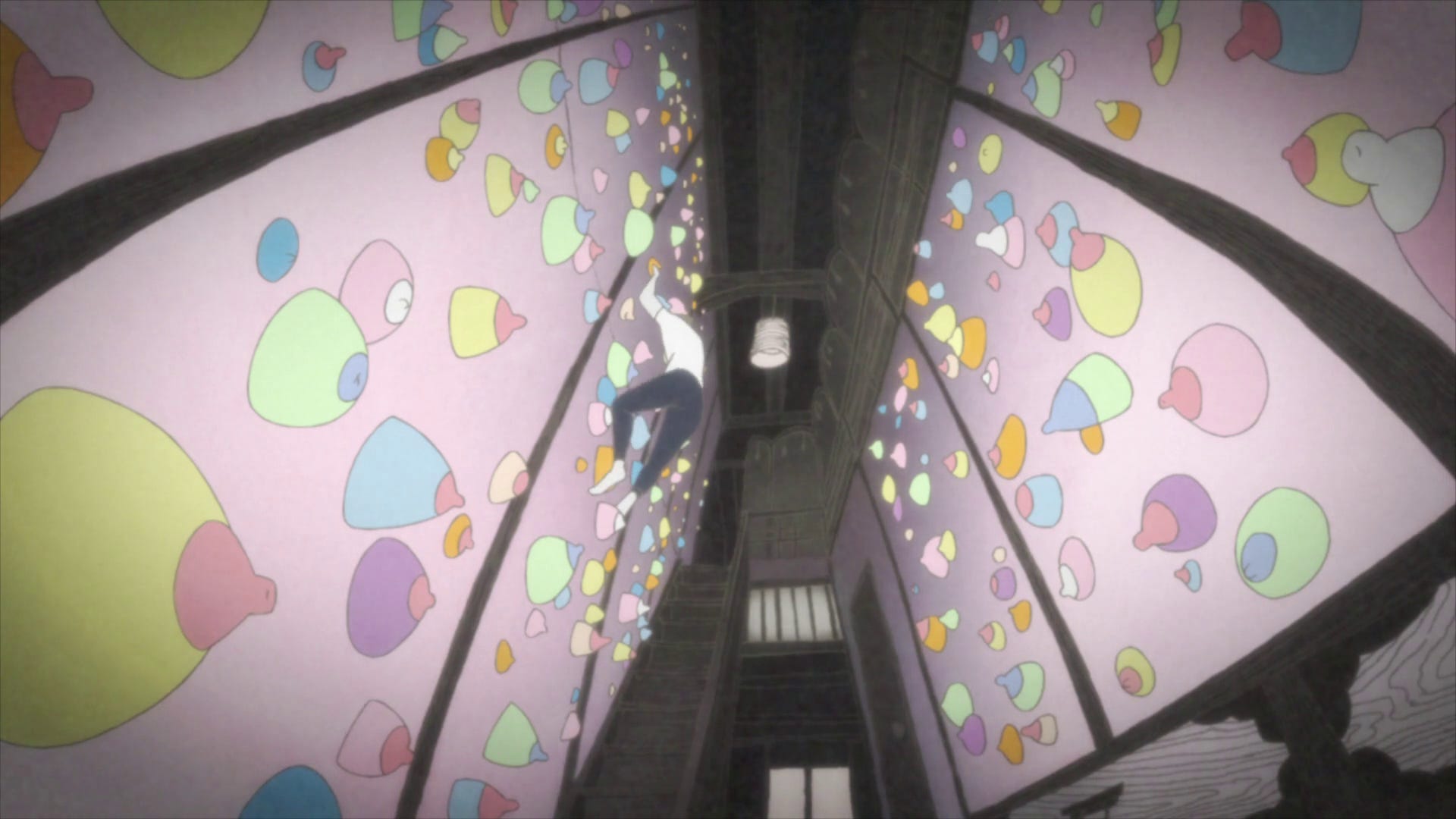
When you’re in college, especially in the earliest parts of it, there’s a togetherness between you and your peers built on a vernacular, a know-how, and a collection of absurdities. When you grow out of it, you look back fondly and feel an extremely specific nostalgia. The Tatami Galaxy is a collection of these moments, these campus absurdities. In the second episode, “Movie Circle Misogi”, the admired President of the Film Club is secretly a pervert who’d installed a climbing wall in his home where all the handholds were fashioned to look like breasts. He’s exposed in a shocking tell-all documentary by his campus rivals.
Our main character simply refers to himself as “I”, or in Japanese 私 (romanized as watashi). He tries the tennis club, the film circle, and even the English club, and every time without fail, he suffers self-imposed unfulfillment and isolation. At the end of his wretched episode, anguished by defeat when he doesn’t achieve the sparkling happiness and sense of belonging he sought, the clock turns back and he chooses something different. There are many consistencies. Mentions of a red string of fate, an ill-fated “first contact”, and an encounter with a psychic that hikes her prices every episode provide the show with a Groundhog Day-esque cohesion. A malicious frenemy, Ozu, leads our unnamed main character astray and sabotages him. There is a quiet underclassman with whom he shares a tender and teetering friendship. There is a deity of chance that he runs into at a ramen stall. There’s a dental hygienist that speaks vivacious (if grammatically incorrect) English and can’t hold her liquor.
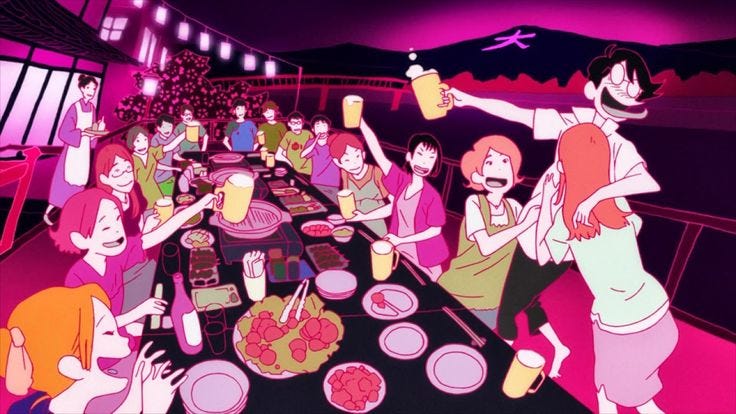
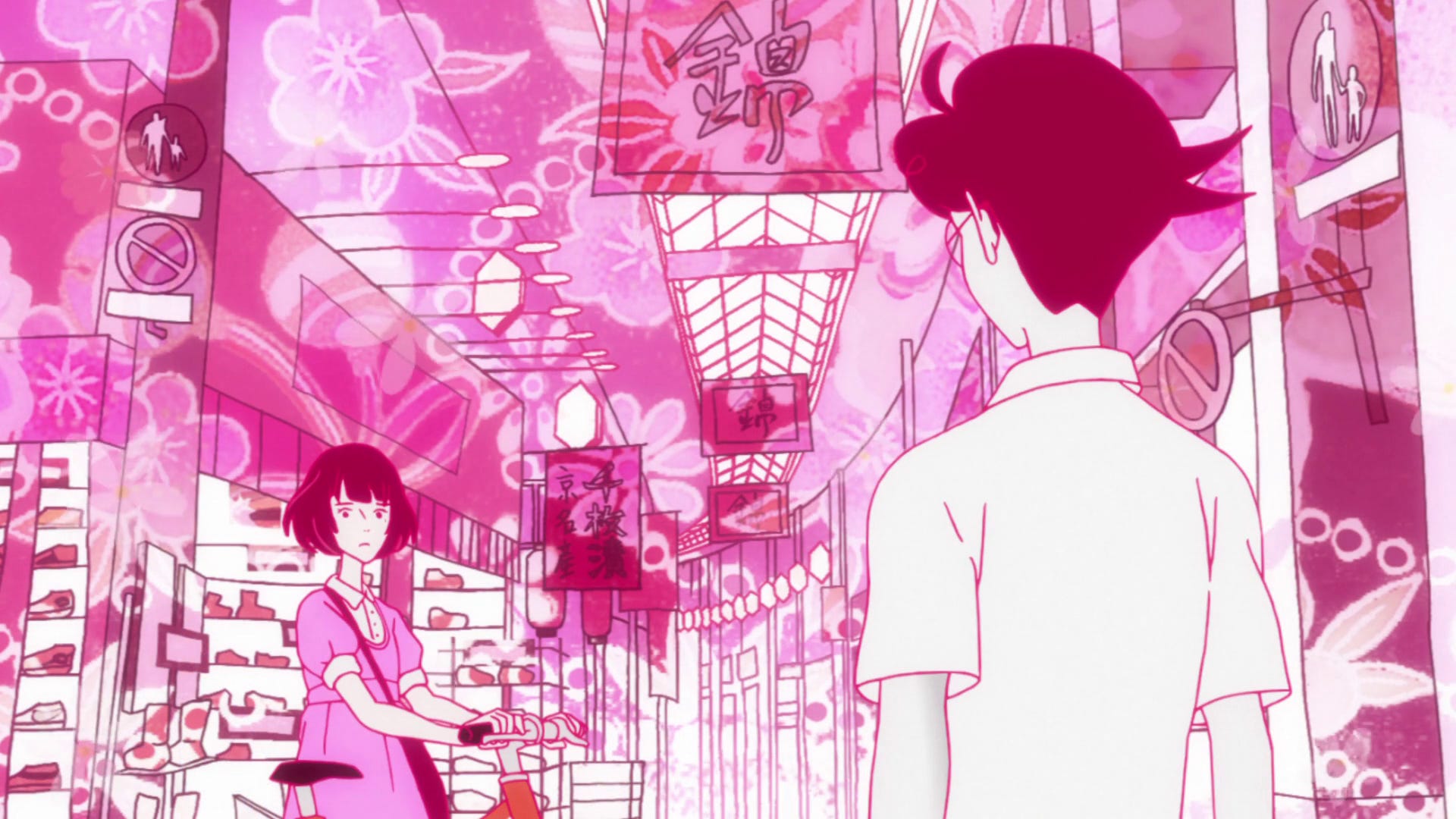
Tatami Galaxy is beautiful. It is one of the most stunning works I feel I’ve had the luck to experience. The narration is in keeping with Yuasa’s style of frenetic rhythm and it feels like a bombardment. Coincidentally, so does young adulthood. Traditional Japanese motifs leap out from the screen and decorate the backgrounds of the settings in yuzen patterns and gold foil details. The artists are unafraid of glorious technicolor. Yuasa tends to distort the appearance of his characters into inhuman incarnations to insinuate secondary meanings to his audience. In front of pretty girls, our protagonist becomes a Cubist sketch drawn by Picasso’s hand to reflect his rigidity and confusion. When he drinks, he glows, not just in red but in neon colors. We see double through his perspective. We see the floor get closer when he crashes into it. When our main character has moments of clarity about his life and purpose, we see sweeping landscapes, we see the sky at sunset. We are visually reminded of the narrator’s simultaneous smallness and determinism. Ozu loses his flat, menacing gaze and becomes rounder and more childlike when the main character voices his increased empathy. The series illustrates the internal biases of our main character and changes them over time to reflect his growing maturity and understanding of the world.

Yuasa is known visually for his seemingly simple but effective line art, and you’ll notice that his animation style is characterized by a flow of constant movement or dialogue. The series is also defined by its narration, and at hyperspeed, gives the same effect as the source novel’s stream-of-consciousness style.
たたみます (tatamimasu) is a Japanese verb that means to fold or to pile. Japanese-style straw tatami mats are made by looping straw through a frame and folding the fibers back on themselves over and over again. The Tatami Galaxy tells us in its name that our lives, our galaxies, are simultaneously built AND stifled by our propensity to do the same things over and over again. In an increasingly isolationist world, where we can escape to our rich, digital inner lives, this project underscores the importance of not just friendship and trust, but the courage it takes to try new things and absolutely fail at them. This show presents a challenge to its viewer and proposes an exercise in self-reflection and an embrace of the unknown.
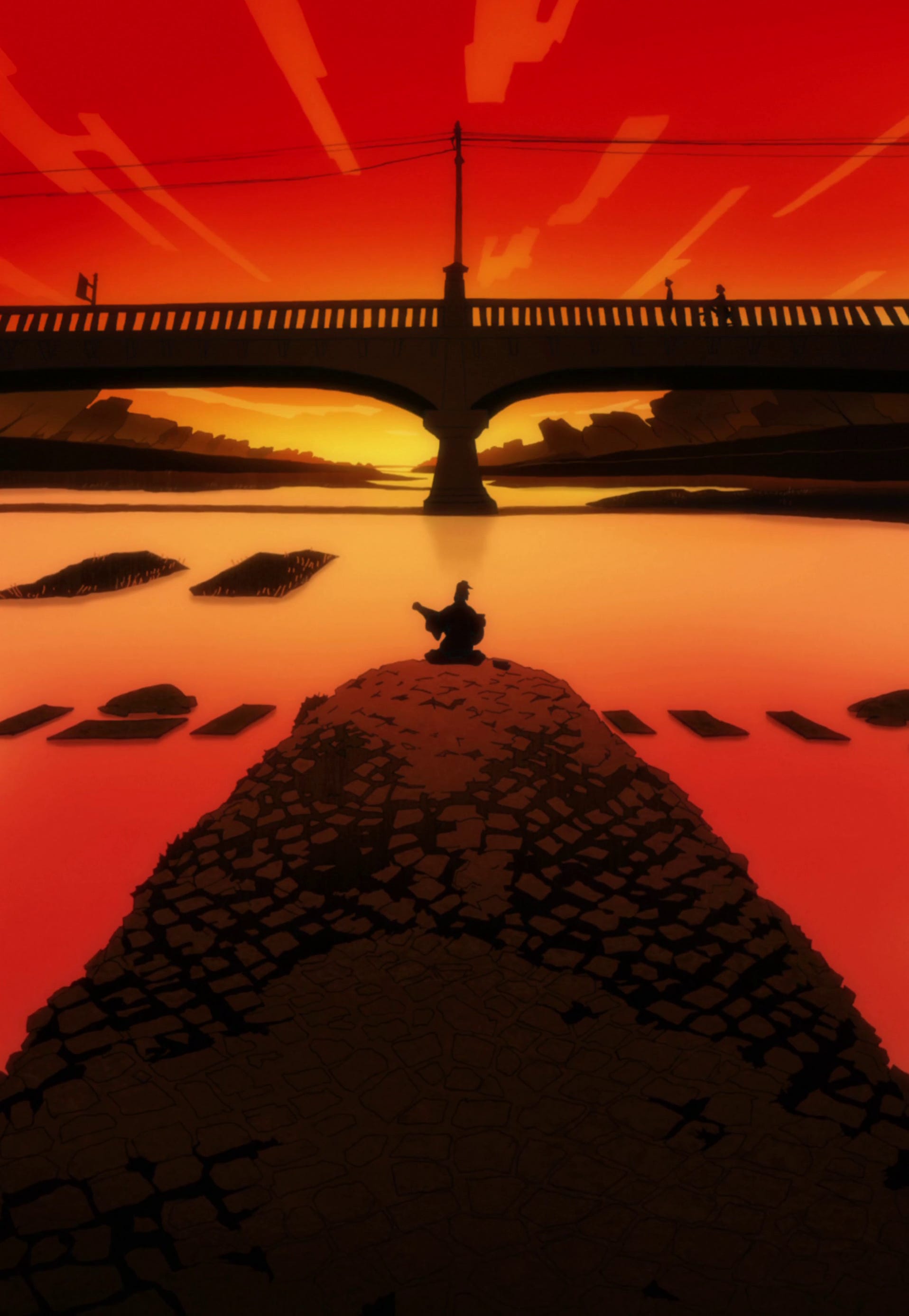
I have just two recommendations for you, my dear readers. The first is to watch The Tatami Galaxy, especially if you’re embarking on something new. A new job, a new school, a new city— you get it. The second is that whenever you watch animation that absolutely dazzles you, I urge you to consider your consumption. When we watch live-action, the faces onscreen are immediately recognizable to us. The directors/actors/writers of acclaimed live-action TV and movies are celebrated in a way that the minds behind animation are simply not. I recommend that you take the time to understand the people who created your most beloved characters and look into what they’re getting paid to entertain you. These assiduous people deserve a living wage too.
Animation probably raised you, and the reason you should respect it is that it respects you. When details are as minute as the arch of an eyebrow or the swish of a skirt, every single second of your time is cherished and every intricacy in every frame seeks your eye.

Rishi’s Animated Recommendations:
Movies: Makoto Shinkai’s 5 Centimeters Per Second (2007), Redline (2009), anything Studio Ghibli but ESPECIALLY The Tale of Princess Kaguya (2013), Wes Anderson’s Fantastic Mr. Fox (2009), Ghost in the Shell (1995), the Spider-Verse movies, and Masaki Yuasa’s other Morimi adaptation: The Night is Short, Walk on Girl (2017)
TV: Pendleton Ward’s The Midnight Gospel, Love Death & Robots (2019) specifically Alberto Mieglo’s Jibaro and The Witness, Samurai Champloo (2004)
Shorts: Hammerhead, Au Revoir Jérôme !, Louise, Last Summer, Best Friend (Isabel’s rec)
banger wowowowwow worth the wait 100x